College Basketball Recruiting: Data Analytics in 2025-2026 Season

Data analytics is revolutionizing college basketball recruiting for the 2025-2026 season, providing programs with sophisticated tools to identify, evaluate, and secure top talent more effectively than ever before.
The landscape of college basketball recruiting analytics is undergoing a profound transformation, particularly as we look ahead to the 2025-2026 season. Top-tier programs are increasingly leveraging advanced data analytics to gain a competitive edge, moving beyond traditional scouting methods to a more precise, data-driven approach. How exactly are these sophisticated tools changing the game?
The Evolution of Scouting: From Eyeball Test to Algorithms
For decades, college basketball recruiting relied heavily on the ‘eyeball test’ – coaches and scouts traveling to observe prospects in person, trusting their instincts and experience to identify future stars. While invaluable, this method often suffered from subjectivity and geographical limitations. The advent of data analytics has not replaced this human element, but rather augmented it, providing a more objective and comprehensive layer of evaluation.
In the 2025-2026 season, programs are integrating vast amounts of data, from basic statistics to advanced metrics, to build detailed profiles of potential recruits. This shift allows for a deeper understanding of a player’s true impact, beyond what traditional box scores reveal. The focus has moved from merely identifying talent to understanding how that talent will translate into a specific system and contribute to team success.
Beyond Basic Stats: Advanced Metrics in Action
Modern recruiting goes far beyond points, rebounds, and assists. Coaches are now examining advanced metrics that quantify efficiency, defensive impact, and decision-making under pressure.
- Player Efficiency Rating (PER): A per-minute rating of a player’s statistical accomplishments.
- Usage Rate (USG%): Estimates the percentage of team possessions a player uses while on the floor.
- Defensive Box Plus/Minus (DBPM): Measures a player’s defensive contributions per 100 possessions.
- True Shooting Percentage (TS%): A measure of shooting efficiency that accounts for field goals, three-pointers, and free throws.
These metrics paint a more complete picture of a player’s abilities and potential. They help identify hidden gems whose traditional stats might not stand out, but whose advanced numbers suggest a high ceiling for collegiate success. The ability to filter and analyze these data points quickly provides a significant advantage in a highly competitive recruiting landscape.
The transition from purely subjective evaluation to a data-informed approach marks a significant milestone in college basketball recruiting. It enables programs to make more informed decisions, reducing the risk associated with high-stakes scholarship offers and fostering a more strategic approach to talent acquisition.
Identifying Undervalued Talent: The Analytical Edge
One of the most significant advantages data analytics offers in college basketball recruiting analytics is the ability to uncover undervalued talent. Traditional scouting often gravitates towards players with flashy statistics or those playing in high-profile events. However, analytics can reveal prospects whose contributions are less obvious but equally, if not more, impactful.
A player might not score 20 points per game but could have an exceptionally high assist-to-turnover ratio, strong defensive metrics, or an elite ability to create space for teammates. These subtle yet crucial attributes are easily highlighted through data analysis, allowing programs to identify players who might be overlooked by competitors relying solely on conventional scouting.
Predictive Modeling for Future Success
Beyond current performance, data analytics is increasingly used for predictive modeling. Programs are developing algorithms that forecast a recruit’s potential growth and fit within their system. This involves analyzing historical data of similar players, considering physical development, skill progression, and adaptability to new environments.
- Physical Development Projections: Predicting how a player’s body might evolve, impacting strength and athleticism.
- Skill Translation Analysis: Assessing how a player’s high school skills will adapt to the faster, more physical college game.
- System Fit Compatibility: Evaluating how a player’s playing style aligns with a program’s offensive and defensive schemes.
- Character and Leadership Indicators: While harder to quantify, some models attempt to integrate qualitative data on leadership and coachability.
This predictive capability helps programs make long-term strategic decisions, investing in players who are not just good now, but who possess the highest probability of becoming exceptional collegiate athletes. It’s about seeing beyond the present and envisioning the future impact a player can have on a roster.
The analytical edge in identifying undervalued talent and predicting future success is rapidly becoming a cornerstone of competitive college basketball recruiting. It allows programs to optimize their recruiting budgets and focus their efforts on prospects who genuinely align with their long-term vision and tactical needs.
Maximizing Player Fit: Beyond Raw Talent
In the past, recruiting often focused on acquiring the most talented individuals, assuming they would naturally blend into the team. However, modern college basketball recruiting analytics emphasizes player fit as much as raw talent. A highly skilled player who doesn’t fit the team’s culture, playing style, or academic environment can be detrimental to overall success.
Data analytics helps coaches assess how a recruit’s individual strengths complement the existing roster and the strategic direction of the program. This holistic approach ensures that every new addition enhances team chemistry and on-court performance, rather than disrupting it. It’s about building a cohesive unit, not just collecting individual stars.
Team Chemistry and Positional Needs
Coaches are using data to analyze not just individual player stats, but also how players perform together. Analytics can identify optimal player combinations, highlighting recruits who excel in specific roles that address current or future team needs. This might include finding a pass-first point guard to complement a team of prolific scorers, or a versatile defender to shore up weaknesses on that end of the floor.
Furthermore, analytics can help project how a recruit might impact team chemistry. While this remains largely qualitative, data can inform discussions around a player’s on-court demeanor, leadership qualities, and ability to adapt to different team dynamics. The goal is to avoid bringing in a player who, despite their talent, might negatively affect team cohesion.
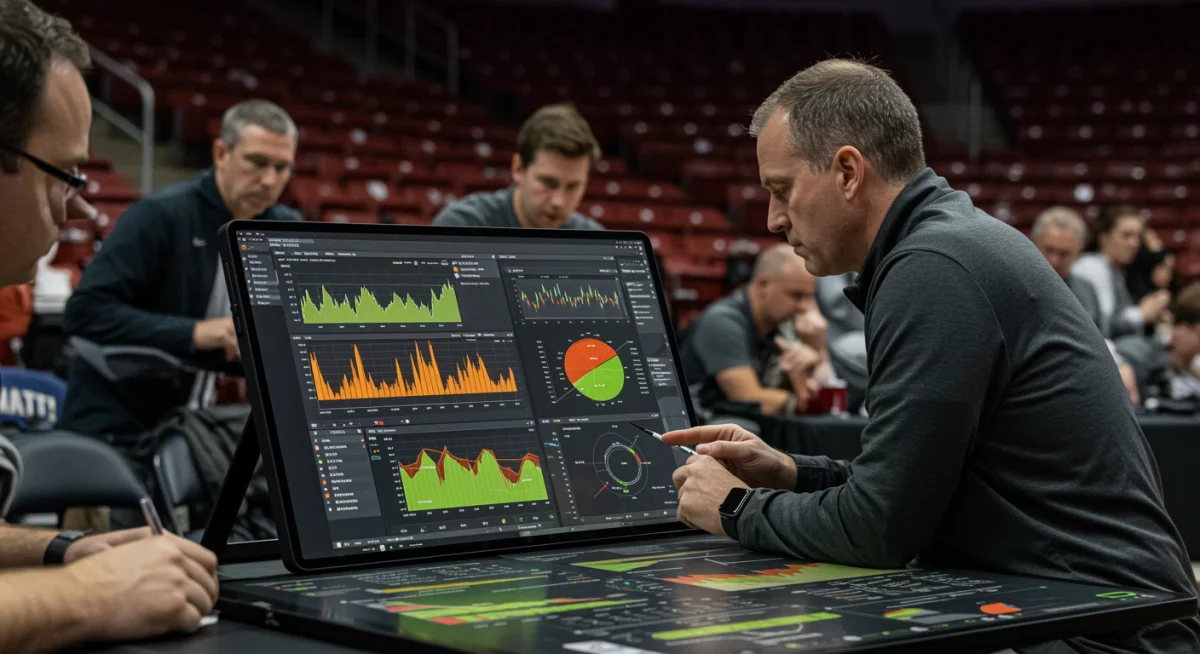
The focus on maximizing player fit through data analytics represents a mature evolution in recruiting strategy. It acknowledges that success in college basketball is a collective endeavor, and the right combination of talent and personality is paramount. This strategic pairing ensures that recruits are not just joining a team, but becoming integral components of a successful program.
Recruiting Efficiency: Optimizing Time and Resources
Recruiting is an incredibly time-consuming and resource-intensive process. Coaches and their staff spend countless hours traveling, evaluating, and communicating with prospects. In the 2025-2026 season, college basketball recruiting analytics is proving invaluable in optimizing this process, making it significantly more efficient.
By leveraging data, programs can quickly narrow down their target lists, focusing their efforts on prospects who are the best fit both athletically and academically. This targeted approach reduces wasted travel and communication, allowing recruiting staff to concentrate on building meaningful relationships with the most promising candidates.
Streamlining the Evaluation Process
Data platforms now consolidate a recruit’s game footage, statistical profiles, academic records, and even social media activity into a single, accessible dashboard. This streamlines the initial evaluation phase, allowing coaches to quickly assess a large pool of candidates before committing to in-person visits.
- Centralized Player Profiles: All relevant data points for a recruit in one place.
- Automated Highlight Generation: AI-powered tools can create highlight reels based on specific statistical criteria.
- Academic Qualification Tracking: Ensuring prospects meet NCAA eligibility requirements early in the process.
- Communication Tracking: Logging interactions and progress with each recruit.
This efficiency extends beyond initial identification. As recruiting progresses, analytics can help track the likelihood of securing a commitment from a prospect, identifying potential red flags or areas where more attention is needed. This allows programs to allocate their resources strategically, maximizing their return on investment in the recruiting process.
Optimizing recruiting efficiency through data analytics is not just about saving time; it’s about making smarter decisions faster. In a highly competitive environment where every advantage counts, the ability to quickly and accurately identify, evaluate, and pursue top talent is paramount for sustained success.
The Role of NIL and Transfer Portal in Analytics
The advent of Name, Image, and Likeness (NIL) deals and the NCAA Transfer Portal has added new layers of complexity to college basketball recruiting analytics. Programs must now consider not only a recruit’s on-court potential but also their marketability and their likelihood of staying with the program through the transfer portal era.
Data analytics is being adapted to model these new variables, helping programs navigate the financial and roster management challenges they present. The 2025-2026 season will see an even greater reliance on data to manage these dynamic aspects of collegiate athletics.
NIL Valuation and Impact
Colleges are beginning to use data to estimate the potential NIL value of recruits. This involves analyzing social media engagement, brand appeal, and athletic performance projections. Understanding a recruit’s NIL potential can be a significant factor in attracting top talent, as players increasingly weigh these opportunities when making their college decisions.
Furthermore, analytics can help programs understand the financial impact of NIL deals on team dynamics and budget allocation. It’s about finding a balance that benefits both the athletes and the institution, ensuring that NIL opportunities are leveraged effectively without disrupting team cohesion.
Navigating the Transfer Portal
The transfer portal has transformed roster construction, making it an ongoing process rather than an annual event. Data analytics is crucial for identifying potential transfer targets who can immediately fill roster gaps, as well as predicting which current players might consider entering the portal.
- Transfer Market Analysis: Identifying trends and available talent in the portal.
- Roster Gap Identification: Using current team data to pinpoint specific needs that can be addressed by transfers.
- Retention Analytics: Modeling factors that influence a player’s decision to stay or leave a program.
- Performance Projection for Transfers: Assessing how a player’s previous performance will translate to a new system.
The integration of NIL and transfer portal considerations into data analytics makes the recruiting process more dynamic and complex. Programs that effectively leverage these analytical tools will be better positioned to build and maintain competitive rosters in the evolving landscape of college basketball.
Ethical Considerations and Future Outlook
As college basketball recruiting analytics continues to advance for the 2025-2026 season, ethical considerations become increasingly important. The vast amount of data collected on young athletes raises questions about privacy, fairness, and the potential for over-reliance on numbers at the expense of human judgment.
Programs must establish clear guidelines for data collection and usage, ensuring transparency with recruits and their families. The goal is to use data as a tool to enhance decision-making, not to dehumanize the recruiting process or create unfair biases. Maintaining a balance between data-driven insights and personal connection remains crucial.
Ensuring Fairness and Transparency
The ethical framework for data analytics in recruiting should address:
- Data Privacy: Protecting personal and performance data of recruits.
- Bias Mitigation: Ensuring algorithms do not perpetuate existing biases in sports.
- Transparency: Clearly communicating how data is used in the evaluation process.
- Holistic Evaluation: Emphasizing that analytics are one component of a broader assessment.
Looking ahead, the future of college basketball recruiting will likely see even more sophisticated analytical tools, including real-time biometric data, advanced psychological profiling, and AI-driven simulation models. These innovations will further refine the ability of programs to identify and develop talent.
However, the human element—the coach’s ability to inspire, mentor, and connect—will always remain indispensable. Data analytics will continue to evolve as a powerful assistant, providing insights that empower coaches to make more informed decisions, but it will not replace the art of coaching and the personal touch in recruiting. The challenge and opportunity lie in harnessing technology responsibly to foster a more equitable and effective recruiting environment.
| Key Aspect | Description in 2025-2026 Recruiting |
|---|---|
| Advanced Metrics | Beyond basic stats, programs use PER, USG%, DBPM, and TS% for deeper player evaluation. |
| Predictive Modeling | Algorithms forecast recruit growth, skill translation, and system fit for long-term strategy. |
| NIL & Transfer Portal | Analytics assess NIL potential and aid in navigating the complexities of the transfer market. |
| Ethical Framework | Ensuring data privacy, fairness, and transparency in the use of analytical tools for recruiting. |
Frequently Asked Questions About Data Analytics in Recruiting
Data analytics complements traditional scouting by providing objective, in-depth player evaluation beyond the ‘eyeball test.’ It offers metrics on efficiency, defensive impact, and decision-making, allowing coaches to identify hidden talent and make more informed decisions about a recruit’s potential.
Beyond basic stats, key metrics include Player Efficiency Rating (PER), Usage Rate (USG%), Defensive Box Plus/Minus (DBPM), and True Shooting Percentage (TS%). These advanced statistics offer a granular view of a player’s contributions and efficiency on the court.
Analytics help assess how a recruit’s individual strengths complement the existing roster and team strategy. It identifies optimal player combinations, addresses specific positional needs, and can inform discussions about a player’s potential impact on overall team chemistry, ensuring a cohesive unit.
Data analytics now models NIL potential, helping programs attract talent based on marketability. For the Transfer Portal, analytics identifies ideal transfer targets to fill roster gaps and helps predict player retention, making roster management more dynamic and strategic.
Ethical concerns include data privacy, mitigating algorithmic biases, and ensuring transparency with recruits. Programs must balance data insights with human judgment, using analytics as an enhancement to the recruiting process rather than its sole determinant, fostering fairness.
Conclusion
The integration of data analytics into college basketball recruiting for the 2025-2026 season represents a pivotal shift, transforming how top-tier programs identify, evaluate, and secure talent. From advanced metrics that reveal hidden potential to predictive modeling for future success and strategic navigation of the NIL and transfer portal landscapes, analytics provides an unparalleled competitive advantage. While technology continues to evolve, the human element of coaching and personal connection remains vital, ensuring a balanced and ethical approach to building championship-caliber teams. The future of college basketball recruiting is undoubtedly data-driven, precise, and more strategic than ever before.